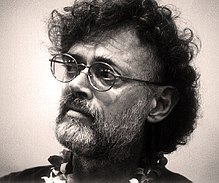
I’ve been listening to a lot of Terence McKenna lately.
I admit this is in part because he is a connoisseur of the English language. One could argue that he is/was a modern day bard. He speaks in a kind of lilting meter.
However, the deeper reason for listening is the subject of his lectures, the content, which is oriented around the psychedelic experience and the interaction of hallucinogenics with the human psyche. In a world where culture increasingly distorts knowledge and leads to battles between differing ideology, McKenna is a breathe of fresh air for for anyone interested in the unknowns that lie beyond standard accepted fact and theory. A drug smuggler turned art historian turned biologist, he has an uncanny eye for detail which he uses to explore the great grey areas of life as well as radical ideas that pertain to the functioning of the human mind. His objective is simple and stated often: to challenge the rational-spiritual awareness of any listening.
—————————
Now, a preemptive defense against those who ride the straight arrow and are already incredulous:
McKenna is not a zealot spouting revolutionary commandments. He is not a cult leader. He’s just a regular guy, albeit it with an extraordinary view of the world. The fact that he has used, and advocates, hallucinogenic substances is often taboo enough to drive many away. Thus the defense.
The first point to make is that the majority of his statements are supported by evidence and a pristine logic. He is, after all, a certified scientist.

A snapshot of Berkeley in the 60’s.
The second point is that he grew up around UC Berkeley during the late ’60’s, a hot bed for human rights and an arguable tipping point for the drug-craze that continues to this day. This leads one to the realization that he has more firsthand experience with this movement than many experts today.
Thirdly, a subjective defense that depends on intuition (so worthless to the pure rationalists among you): there’s an earnestness to McKenna that is hard to deny, no matter who the listener. He prizes clarity above all, humor second, and uses these strategies to ferry the audience between the psychedelic world and the world of “civilized” living we’re all familiar with that starts with our morning coffee at 6 and ends with a family BBQ out back.
So ends the defense. Make your judgment. To those who remain, we’re moving along.
—————————
McKenna is a wordsmith. It’s easy to listen to him. And his observations concerning hallucinogenics are astonishing.
For someone who has experienced mind altering substances, I’m familiar with the myriad neurological responses they can evoke. If you’ve heard the famous line by William Blake, “To see the world in a grain of sand/And heaven in a wildflower/Hold infinity in the palm of your hand/And eternity in an hour,” know that this is possible while under the influence of these chemicals. McKenna might say it is only possible while under the influence of these substances. It’s not a stretch to claim that one could never have this experience otherwise…(here I could bring up a parallel to Moses and the burning bush, but having tested your resolve just by writing this bit I’ll tactfully refrain).
If these illuminating and otherworldly experiences are only possible thanks to hallucinogenics, as seems the case for those of us not practiced Tibetan monks, then it seems apparent that they are a tool, a lens through which people might experience a connection to the world that is normally beyond their reach. For a moment the invisible world becomes visible. We see what we have never seen and begin to think ideas we have never thought.
And isn’t that what being alive is about? The plunge into uncertainty, followed by the resurgence with new understanding? Isn’t that how we move forward, learn, grow, discover?
There is always the hint of a greater mystery in his lectures. One that our hearts can touch, but our language can’t touch. His carefully crafted stories can only carry the audience so far. The experience itself is what matters in the end. Whether sex or swimming in the ocean or falling from height, until a person experiences them these things are only words. The surreal world brought to the fore by hallucinogenics is the same. It is is beyond the boundaries, undefinable.
This is the obstacle McKenna faces. He has seen but he cannot say, no matter how quick his tongue. How does a teacher explain an experience that can’t be sketched on the blackboard or broken up into a bulleted list of descriptors?
This is a difficult problem to circumnavigate. Doubly so when there are many in the audience who have never experienced a psychoactive agent.
So what does McKenna say about his time spent deep sea diving in a world completely alien?
Well, mainly that it’s shown him as many questions as answers. He often points out the importance of embracing uncertainty, and won’t hesitate to reveal when he doesn’t have answers. This kind of humility is rare on the academic stage, and endearing. If my defense early didn’t convince you to give a listen, maybe this might. No real wise man was ever ebullient. The truth doesn’t need a strong-arm, it stands well enough on its own.
The reason he professes ignorance easily and often is because acknowledging uncertainty is key to moving forward.
Uncertainty is empty space. Empty space means there’s room to grow. An uncertain mind isn’t fixed in its ways but is instead malleable, quick, reactive to change. A dogmatic mind less so. Someone who’s spent their whole lives believing that 1 + 1 is equal to 2 isn’t likely to discover a new form of mathematics — an extreme example maybe, but ideas become clearer when they are framed in ways you don’t expect.
Still, resolve is necessary to balance out this kind of catalytic uncertainty, this liberating sense of not-having-an-answer. If you don’t have answers and you don’t have the resolve to look for them you’ll be suspended in a never-ending freefall — doubt everything and you wind up believing nothing. Then where are you supposed to stand?
McKenna’s lectures orbit around this principle of balance, this peculiar yin-yang quality that keeps the world in perpetual motion. I see this balance everywhere. The push and pull of the tide. The ovoid, elliptical orbit of the earth around the sun. The rhythmic motion of sex. The anatomy of the human brain as well. I can imagine the friction between it’s two opposing hemispheres working like a set of those pendulum balls you might have seen in a movie on some CEO’s desk. Left brain and right brain batting electrochemical charge back and forth until there’s enough energy to set the body in motion.

The principle is that inertia is sent back and forth, back and forth. No energy gained, no energy lost. Perpetual motion. McKenna’s exploration of this idea breaks the ice that continually threatens to gridlock my own faculties of critical thought.
What I’ve learned from him is this: in order to grow at all we can’t allow fear to stop us from leaving our familiar state of mind, our comfortable yet unchallenged beliefs, behind. As another wise man once said, “It’s not possible to solve your problems with the same frame of mind you used to create them.”
Children intuitively understand this. The monks and shamans and witch doctors of the ancient world are others who did as well. For mellenia, they have devised ways to dip into new states of being. Some use rhythmic breathing or sounds to hypnotize. Others use crude herbal remedies. Still more use communal song and dance, physical sensation, ascetic behavior.

Modern psychedelics, however, are more refined and widespread than any of these dated rituals. They are more effective at altering state of mind than primitive practitioners could ever have imagined. Some can dismantle beliefs we have spent our lives reinforcing in a matter of minutes.
And here, at last, we arrive at the prime reason drugs are taboo: they force us to rigorously examine the way we live our lives. Lot of people don’t like that. “Worked hard to learn what I’ve learned,” they might say, “and I’ve used the things I learned pretty good.” And they may well have. And they might not.
Hallucinogenics often demand deep introspection, and in that state lying to ourselves doesn’t go over too well. The result is a cognitive dissonance that comes from denying what we sense is true. However, if we don’t turn away from ourselves we’re granted the privilege of seeing deeply into who we are. There we discover that the who we are isn’t so important as the what we are. And with that knowledge comes new responsibility. When we see what we are we become responsible for what we do. Our eyes are opened to our affect on the world and the things we can change.
So again, I circle back around to why drugs are taboo: they force us to examine ourselves and our beliefs, and they give us the ability to break down outdated values and start over. No dogma here.
—————————
[And why would anyone want to dissemble their beliefs?
Maybe they’ve crashed on an island with no food other than coconuts. Sadly, they hate coconuts. Hate them so bad they’d rather die than eat even one. So maybe they start withering away and then they realize they are actually going to die. One day they find a patch of mushrooms. Hooray, real food. Said individual eats them all in one day. Said mushrooms happen to contain psilocybin. Our stingy hero undergoes a fervent hallucinogenic experience all through the night, emerges the following morning hungry and having analyzed the food situation clearly. There are no more mushrooms. All gone. Not likely to grow back quickly either. Back to coconuts. Tried to remember during the night why they didn’t like coconuts. Remembered being struck by one on the arm while sleeping on a faraway beach years ago. So, really, no real reason to hate the taste of them. Just a bad experience way back when after all. Meaningless now. Coconuts probably taste good. Oh! They do…
How’s that for a brief allegory?]
—————————
There is a theory in cognitive science that claims once we develop a set of beliefs we’re more likely to distort fact to support it rather than challenge it. This is called “confirmation bias,” and we’re all susceptible to it. Conviction isn’t synonymous with right judgement, yet we often confuse the two as the same. This kind of thinking causes us to hold onto often-erroneous beliefs for a variety of reasons moral, existential, and emotional.
Most of us believe our beliefs make us who we are, that if we were to change them we wouldn’t be ourselves anymore and someone else would be living in our skin. But in this model of living our identity becomes more important than being right. We give who we are more value than what we are. And this individualistic pride run rampant on macro-scale causes all kinds of problems, from cliques in the school lunchroom to US and Russia at war. This worship of the ego is the reason Jerry the American can despise Tomas the Russian without the two ever meeting.
Psychoactive substances make hostility like this laughable by revealing the tentativeness of who we are. McKenna phrases things more eloquently than I in the following passage:
“Ego is a structure that is erected by a neurotic individual who is a member of a neurotic culture against the facts of the matter. And culture, which we put on like an overcoat, is the collectivized consensus about what sort of neurotic behaviors are acceptable.”
At the end of the day there’s no Jerry or Tomas or American or Russian. Just two humans protecting sets of beliefs neither is willing to change. And where there is no compromise, there is confrontation. That’s that.
Their belief-disrupting nature is undoubtedly the reason for the aura of fear that surrounds psychoactives. If we take LSD or another psilocybin containing substance and it reveals that what we’ve believed for twenty, thirty, forty years is untrue where then are we left? In a black vacuum of nihilism? How do we dare believe in anything again, knowing that we may spend another lifetime building a worldview only to have it torn down in an instant?
The truth is simple: we have to have courage. Courage to start again on our own, explore ourselves, create our own belief, share it with others, adjust accordingly. And now we’ve learned not to wait twenty years to challenge it. This time we rise each morning with the intent to tear it down. And if it breaks apart under scrutiny, we go back to uncertainty with its empty space and we begin to grow again. And if what we’ve built lives up to the test then we continue to refine it, strengthen it, challenge it, every day. There is no rest. This is how we grow.
And now we’ve become part of the world. Not already-defined characters intent on fighting change, but fluid organisms that embrace it and adapt.
This is what McKenna talks about. This is why I listen.
— Nomad

 Pensive Nomad
Your mail brings back so many memories of my young life when Timothy Leary and Baba Ram Dass appeared on the scene.
Your Aunt Phyllis and I became great followers of Ram Dass and his book
Be Here Now.
We heard him speak many times and he seemed to have an aura about him.
Never did try the mushrooms or drugs.
As medical professionals we saw all to often the results of these drugs as overdosed patients were brought in.
Those days back then were peaceful.
Many a love in at San Francisco.
It was the beginning of something but I don’t like the way it is all headed now.
LikeLiked by 1 person
I can’t claim to have been there at the start with Leary and Ram Dass. Those times were long before me. But I do believe there are things to be learned from what they had to say. Primarily that, somewhere along the way, we began to unknowingly distance ourselves from the natural world and our place in it, and that now we desperately need to rediscover those ties.
That is what these substances enable: a clear perception of our place in the world, as well as the impact our choices have on it.
They are a tool that allow outside-the-box thinking and access to ideas our sober, rational minds would never consider.
Sadly, as your time in the medical industry has no doubt shown, this tool can be sorely misused. And the consequences can be frightening, devastating.
The people who have used them rightly and learned from their experiences are those who treat the experiences more ritualistically. They almost to a man advised taking adequate time in between doses. A recovery stage for the mind to return to its familiar setting. A controlled environment to take them.
I imagine that the many of the damaged patients you saw were victims of substance abuse (very different from intelligent use). Binging is a real danger- not allowing time between trips to recover to a regular state of mind.
The body can handle and pass many of these substances, but it can’t do so indefinitely. You have to allow time to heal. If you have an addiction your body becomes a fortress under siege with no chance to relax.
But you’re right, these tools are largely misused and misunderstood in the context of today’s world. And I consider it a loss when juxtaposed with the insights they can offer.
LikeLike
I totally agree with you.
All those years we followed Ram Dass were really interesting.
I also had the good fortune to spend time with the Tibetan monks who visited California and stayed at a friend of mines huge estate.
Enlightenment!
I look forward to your next reading!’
LikeLiked by 1 person
Great read. I’d like to add that meditation is the best tool for introspection, and that hallucinogenic drugs alike are a nice revelation to what could happen if one became masterful at meditation.
LikeLike
Definitely agree with this. Long practice at meditation and rhythmic breathing is something I strongly recommend to any looking for a deeper connection to themselves. This is a more user-controlled version of the psychedelic experience and a strategy that I feel more people are open to.
When you are the one actively taking steps to push your mind into new places (rather than being forcibly pushed by a substance) you may see the import of the experience even more clearly.
It also drives the point that the ability to develop a deeper awareness of the world is something we’re all capable of. It is a choice we have to make ourselves: whether to isolate or empathize.
Appreciate the comment.
LikeLike
Dear Courageous Nomad
We admire your jouney
Matt and I just saw a Netflix documentary on Timothy Leary and Ram Dass – and recommended it to our kids yesterday
Check out “Dying to Know” it covers their history studying mushrooms and LSD at Harvard and then their later in life discussions about death. We have also read recently that mushrooms are being introduced to severely depressed patients to open up their mids and release them from their repetitive and negative thought patterns. We were discussiing this last night with our friends. Coincidence? I think not.
Stay True and Non judgmental
Love Aunt Karla
LikeLiked by 1 person